


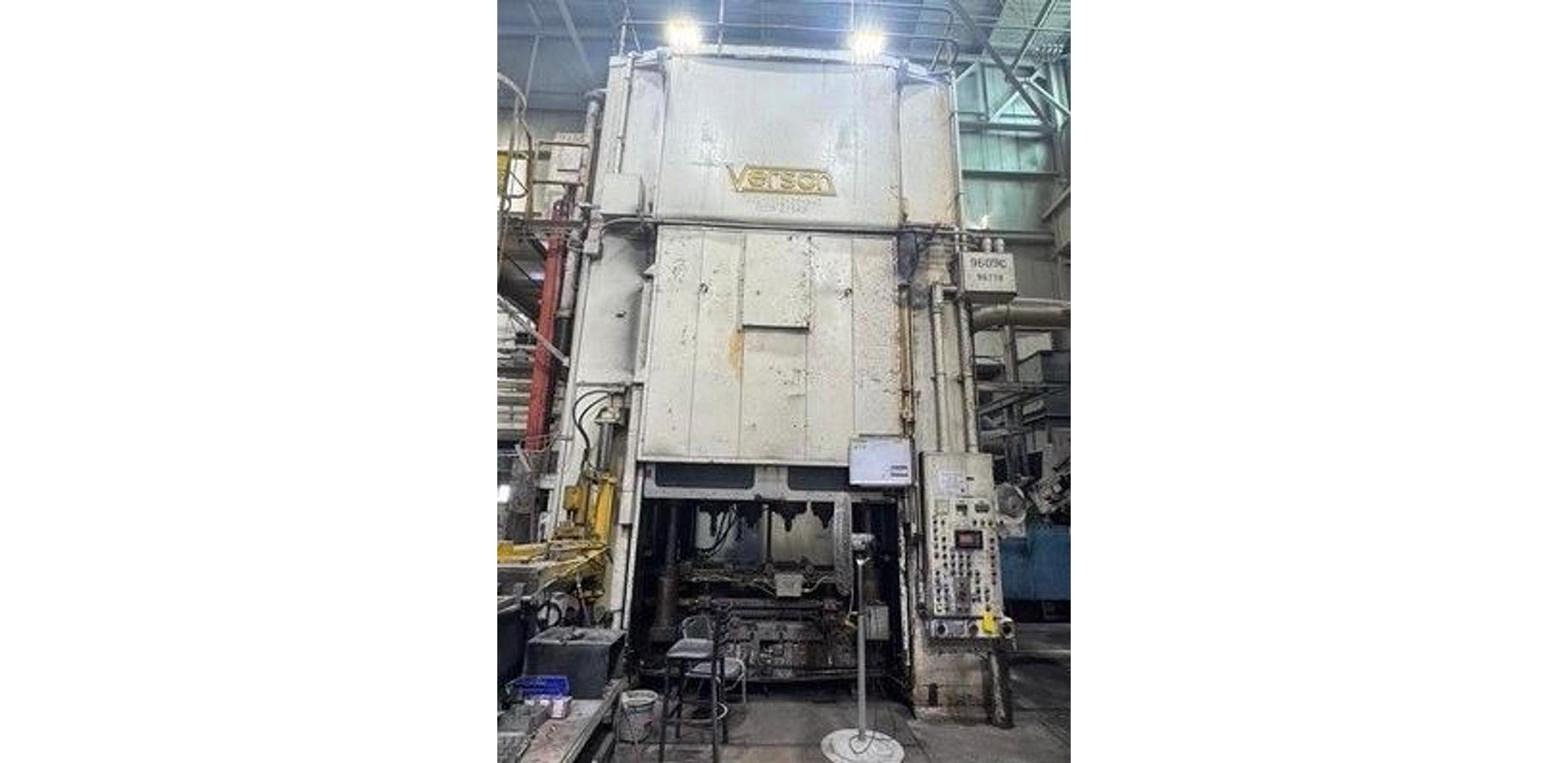
A gap frame press is open on the front and both sides, so it is easy to get at the die, but the frame opens up under load. A straight side press closes the frame with uprights on both sides, so the slide stays parallel under heavy and off-center loads. We stock straight side presses in Imlay City.
How a Gap Frame Press Works
A gap frame, also called a C-frame, is shaped like the letter C. The crown, the upright and the bed form one frame with an open throat in front. That open front is the whole appeal. An operator can reach in, dies go in and out without much trouble, and strip can feed through from side to side.
The trade off is deflection. Under load the throat opens up a little and the slide tips out of parallel with the bolster. On a simple blanking or forming die that may not matter. On a tight progressive die it shows up as punch wear, burrs and parts that drift out of tolerance. The closer you run to rated tonnage, the more it shows.
Gap frames earn their keep on smaller parts, short runs, secondary work like piercing and staking, and cells where a person or a small robot loads each part. A press tending robot such as a FANUC LR Mate 200iD or an FANUC M-10iA/12S fits well beside one. We buy gap frame presses as well as straight sides.
How a Straight Side Press Works
A straight side press is built like a box. The crown sits on two uprights and the uprights sit on the bed. Many straight sides use tie rods that run through all of it and hold the frame together under preload. When the press hits, the frame stretches straight up and down instead of opening like a C. The slide stays parallel to the bed and the die stays in line.
Most of the used presses we carry are double crank. Two connections to the slide spread the load across a wider slide and bolster, so the press handles off-center work better than a single point machine. That is why straight sides run the progressive dies, transfer dies and big panels in automotive and appliance stamping.
They also take automation well. A coil line made up of press room equipment feeds the front, and robots move parts between presses or off the end of the line. Heavy panels call for bigger arms like the FANUC R-2000 series robots or the FANUC M-900iA/260L. More on that in our post on parts transfer robots.
Picking the Right Frame
- Die type. Progressive and transfer dies belong in a straight side. Single station dies and secondary work are fine in a gap frame.
- Off-center loads. If the work is not centered under the slide, or you run several stations at once, a straight side double crank handles it better.
- Part size. Long parts and wide dies need the bed and slide area a straight side gives you. Check bolster size and shut height against your largest die.
- Access. Hand fed jobs and quick die changes are easier on a gap frame. A straight side works through the window between the uprights, so plan where the operator and the material come from.
- Automation. A straight side line with robot transfer units or 7th axis tracks can run one robot down several presses. Plan the end of arm tooling at the same time as the die.
- Floor and foundation. A large straight side often needs a pit or its own foundation. Work that out before you buy, not after the press lands.
- Freight. Presses ship FOB Imlay City, Michigan, and the buyer arranges freight and rigging.
Where the Parts Go Next
The press is one piece of a line. Finished parts come off onto a conveyor or into material handling robots, and from there to a weld line or a cell running palletizing robots. Our FANUC M-410iB/160 is a common pick for stacking at the end, and our used FANUC robots run from small arms for little presses up to heavy arms for big panels. If you are buying the press and the handling equipment together, ask about equipment financing.
Presses and Press Line Equipment We Carry
Stock moves. Check each listing for the model code and year as listed.
- Verson straight side double crank presses: listed models include T-SE2-1500-96-54 (1977 and 1980), S2-500-108-60 (1970) and TS2-500-156-42T (1968). A USI Clearing S4-300-144-72 (1972) is on the same page.
- Perfecto 38-18-5 decoiler: 1976, for feeding coil into a press line
- Cincinnati CBII 90-350 hydraulic press brake: 1998, for bending after the press
- metal shears: Tennsmith A3616 and Wysong 1652
- Smartscan light curtain: never used, for guarding the point of operation
The rest of our forming and cutting stock is under used fabrication equipment.
Related Guides
Have a Press to Sell?
We buy presses and press room equipment, from a single machine to a full plant liquidation. Start with our sell your used presses page, or ask about machinery appraisals if you need a value first.
Want details on a specific press? Call 586-752-0090, extension 1 for sales, or reach our sales team.