


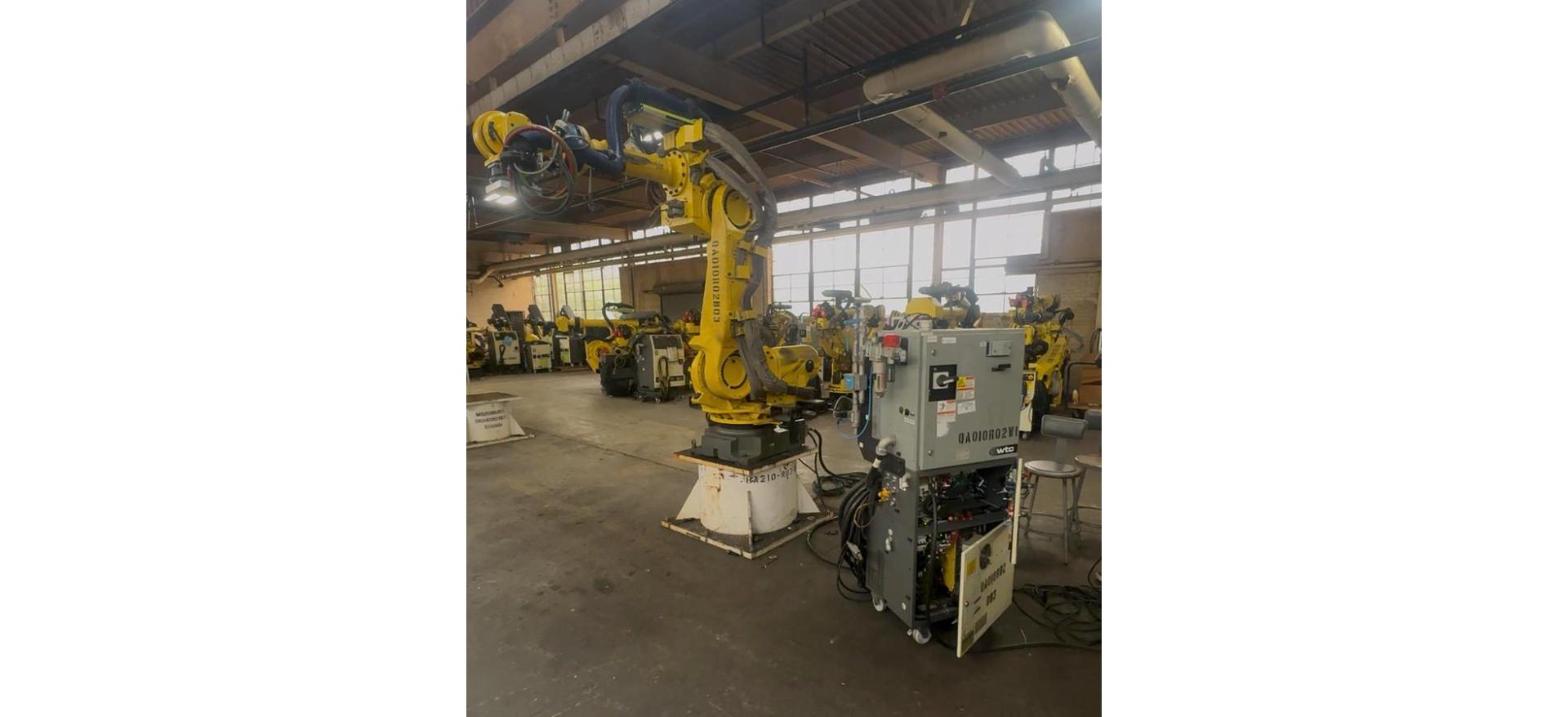
A six axis robot at an injection molding press pulls parts, loads inserts, cuts gates and stacks finished parts, all in one cell. It makes sense when the part has to be turned, trimmed or packed after it leaves the mold. For a part that only drops onto a conveyor, a traditional sprue picker is usually enough.
The Jobs a Six Axis Arm Does at the Press
The basic job is part removal. The robot reaches between the platens when the mold opens, grabs the part with vacuum cups or fingers, and pulls it clear before the next shot. It is the same idea as machine tending on a CNC, with a shorter cycle and a mold that will not wait for you.
Where a six axis arm earns its place is the work that comes after that:
- Insert loading. Threaded bushings, metal inserts or in mold labels go into the tool before the shot. The robot picks them from a nest, places them, and pulls the finished part on the same trip. It is close kin to robotic assembly work.
- Degating and trimming. The arm presents the part to a gate cutter, or carries a small cutter itself, so runners come off at the press instead of at a bench. Heavier finishing falls under robotic material removal.
- Stacking and packing. Parts go onto a conveyor in a fixed orientation, into trays, or into a box in a set pattern. Full cases can then move on to palletizing robots at the end of the line.
- Inspection. With a camera in the cell, the robot can hold each part up for a check before it is set down. Our post on robotic vision applications covers the basics.
Six Axis Arm or Sprue Picker
A sprue picker or a three axis traverse robot bolts to the top of the press and moves in straight lines. It is compact and simple, and for a part that just needs to come out of the mold, it is often the right tool.
A six axis robot stands on the floor beside the press, on a riser, or on a stand above it. It takes more floor space and needs its own guarding. What you get for that is a wrist that can flip the part, change its angle and hand it to a second process. If the part has to be reoriented, trimmed, checked or packed in a pattern, one arm can do all of it.
The other reason is reuse. A sprue picker is built for one kind of machine. A general purpose arm can move to material handling or parts transfer if the molding job goes away.
Sizing the Robot to the Press
Payload. Add up the part, the runner if the robot carries it, and the end of arm tooling. Vacuum frames, sprue grippers and cutters get heavy fast on a big part. If one robot will serve more than one mold, look at robotic quick change tooling so each mold keeps its own gripper. Our FANUC payload and reach quick reference puts the numbers side by side.
Reach. Measure from where the robot base will sit to the far side of the mold, then out to the conveyor or stack. Wide platens push you toward long arm or rack mount robots. A rack mount R-2000 works down from a stand and keeps the floor around the press open; our FANUC R-2000 series guide covers the line. If a floor mount arm needs more height, start with our FANUC robot risers and the write up on when you need a robot riser.
Signals. The robot and the press have to agree on when the mold is open and when it is safe to close. Many molding machines use a standard robot interface such as Euromap 67, and the robot side runs through its I/O. Read our post on industrial robot I/O before you plan the hookup.
What to Check on a Used Molding Robot
- The controller. Know which generation you are buying and ask which software options are loaded. Our guide to FANUC robot controllers covers RJ3 through R-30iB Plus.
- Pendant and cables. Most of our robot listings ship complete with controller, teach pendant and cables. Make sure the cable length works for where the controller will sit next to the press. Our post on robot cable sets explains what to match.
- Air and vacuum. Molding grippers run on air. Look at how the dress pack is routed and whether there is room for your vacuum lines. See our notes on robot cable management.
- Freight. An R-2000iB/165F arm weighs about 1,170 kg before you add the controller. We ship FOB Imlay City, Michigan, and you book the truck, so plan for that weight.
- Budget. Ask about equipment financing if you want to spread out the cost of a cell.
Robots on Our Floor That Fit Molding Work
- FANUC LR Mate 200iD/7L: 7 kg payload, 911 mm reach, for small parts and inserts
- FANUC M-20iA: 20 kg payload, 1,811 mm reach, R-30iB Plus control
- FANUC M-20iA/35M: 35 kg payload, 1,813 mm reach, high inertia wrist for wide grippers
- FANUC M-710iC/70T: 70 kg payload, R-30iA control
- FANUC R-2000iB/165F: 165 kg payload, 2,655 mm reach, R-30iA control
- FANUC R-2000iB/210F: 210 kg payload, 2,655 mm reach, R-30iB control
- FANUC R-2000iB/200R: 200 kg payload, 3,095 mm reach, rack mount, R-30iB
- Kawasaki RS020N: 20 kg class arm, E01 controller
- never used Kawasaki RS020N: the same arm, never put into production
For more on the Kawasaki line, see our Kawasaki RS series guide.
Related Guides
Pulling Robots Off Your Presses?
Shutting down a molding line or moving to new presses? The six axis arms coming off those presses still have value, and we buy them. Start on our sell used robots page, or ask about equipment appraisals if you need a value first.
To talk through a specific robot, call 586-752-0090, extension 1 for sales, or send our sales team a message.